
Reviewed · WAIKIKI SURF LESSONS
Exclusive Group Surfing Lesson with Waikiki Courtesy Shuttle
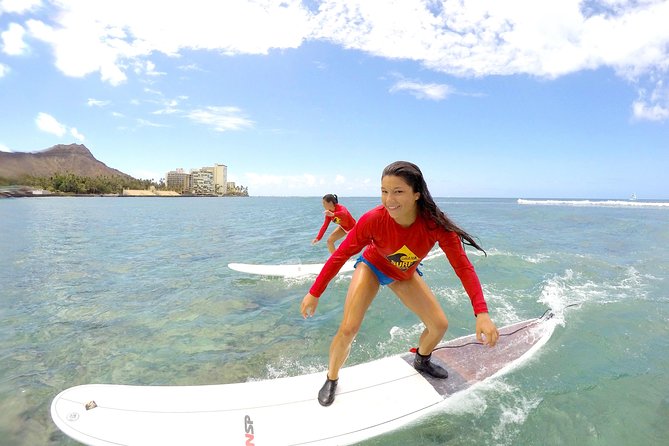
Surfing Waikiki feels like a free movie scene.
I love how this lesson keeps things simple and structured: sand practice first, then you hit the water with an instructor right there. I also like the courtesy shuttle pickup in select Waikiki locations, so you’re not wrestling buses or taxis while you’re trying to get stoked. One possible drawback: even with a more attentive setup, it’s still a group lesson, so if the class runs larger, you’ll likely get fewer wave tries than you’d get in a one-on-one session.
The whole flow is built for first-timers and mixed groups. You start at Ohana Surf Center, gear up quickly, get a safety briefing, and then the team handles the pacing from sand to ocean. If you’re nervous about swimming or balance, that structure matters. If you need extra confidence, plan on asking questions early—seriously, speak up before you enter the water.
In This Review
- Quick take: what makes this surf lesson work
- Getting from Waikiki to the ocean: the yellow bus and Ohana Surf Center
- Check-in, gear, and safety briefing: what happens before you get wet
- Learning the basics on Waikiki’s sand (and why it matters)
- First waves in the water: managing expectations in a group lesson
- Equipment included: what you don’t have to pack
- Photos, videos, and souvenirs: having proof you were there
- Price and value: why $119 can be a smart Waikiki activity
- Who this lesson is best for (and who should adjust plans)
- Timing, what to bring, and practical tips for comfort
- Should you book this Waikiki surf lesson?
- FAQ
- How long is the surfing lesson?
- Where does the lesson start and end?
- Is transportation included?
- What’s included in the price?
- What should I bring?
- Do I need to know how to swim?
- Are souvenir photos included?
- Can I cancel for a full refund?
- Do they offer materials in other languages?
Quick take: what makes this surf lesson work
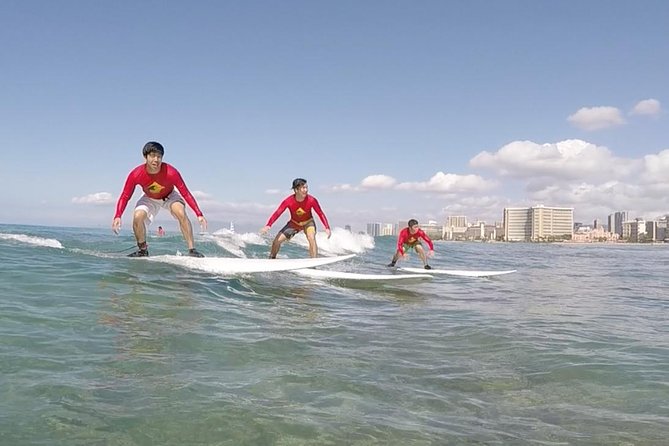
- Waikiki Beach surf coaching in an iconic, beginner-friendly setup where the goal is standing up, not proving a point.
- Ohana Surf Center at the Waikiki Beach Marriott keeps check-in, gear, and post-lesson photo browsing in one place.
- Courtesy shuttle from select hotels plus a clear meet-up point if you’re not in a pickup zone.
- All gear included (rash guard, reef shoes, surfboard), so you show up lighter.
- Small-group attention with real safety time: a briefing before you go out, not after something happens.
- Photo and video add-ons give you something fun to share back home, even if you only catch a handful of waves.
Getting from Waikiki to the ocean: the yellow bus and Ohana Surf Center
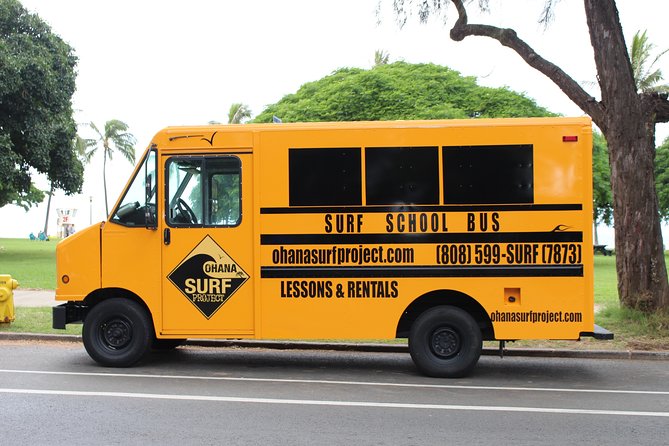
This starts on Waikiki time, meaning you’re not just wandering down to the beach and guessing where the lesson begins. The team meets you at a designated pickup spot in Waikiki (when you’re in their coverage area), then you roll over on a Surf School Bus—often the yellow bus—or a white shuttle with the logo on the side. It’s air-conditioned, easy to spot, and designed for that moment when you’re thinking about sunscreen and where your towels are.
If you’re not using a pickup, your lesson begins at 2552 Kalākaua Ave, Honolulu. Either way, expect a smooth handoff: staff greet you, confirm you’re set, and get you to the Ohana Surf Center located at the Waikiki Beach Marriott. That matters because it reduces the usual “find your tour” stress. You’re not late, you’re not guessing, and you’re not walking around looking for a surf bag while everyone else is already in the lineup.
Once you arrive, you don’t immediately sprint to the water. You check in, get geared up, and sit through the safety briefing. It’s a “let’s get organized” approach that pays off later when you’re trying to focus on paddling and timing.
Catch the gentle Waikiki rollers, more lessons
- Open Group Surfing Lesson in Waikiki, Hawaii★ 4.5 · 582 reviews
- Oahu: Beginner-Friendly Waikiki Beach Surfing Lesson★ 4.9 · 425 reviews
- Surfing Lessons On Waikiki Beach★ 4.5 · 317 reviews
- Waikiki Private Group Surf Lesson★ 5.0 · 298 reviews
Check-in, gear, and safety briefing: what happens before you get wet
Your first big win here is that the lesson doesn’t waste time arguing about equipment. Everything you need is included: a rash guard, reef shoes, and your surfboard. You also get access to a safe place to store belongings, which is huge when you’re bringing a bag, phone, keys, and whatever else you thought you needed for a beach day.
Then comes the part that makes a beginner lesson feel calmer: the safety briefing. You’ll learn how to handle the basics before you’re anywhere near the chaotic part of the ocean. You also watch it at the center, not while you’re already ankle-deep trying to figure it out.
Before the group goes out, your instructor connects with you. They’ll ask about your previous experience and your comfort in the water, plus any concerns or conditions you should share. If you’ve ever done something like stand-up paddleboarding and felt fine, tell them. If you’re a strong swimmer but nervous about wipeouts, tell them too. This is how they tailor cues so you’re not getting random advice that doesn’t match your skill level.
And yes—this is the real deal: you walk your lesson board to the beach, then you leash up and head into the water when you’re ready.
Learning the basics on Waikiki’s sand (and why it matters)
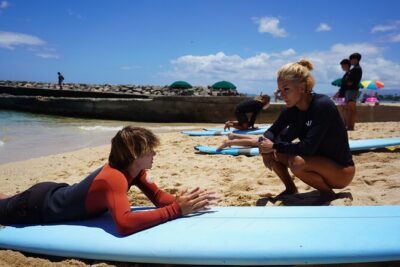
The sand part isn’t just a warm-up. It’s the cheat code that helps you stand up sooner. You’ll start by learning the basics and certain techniques right where you can see what you’re doing—before your brain has to split attention between wave timing, board control, and staying upright.
Here’s what that approach gives you as a new surfer:
- You get repeatable cues for stance and balance.
- You can practice movement without the ocean pushing back immediately.
- You build confidence before you feel the real force of the water.
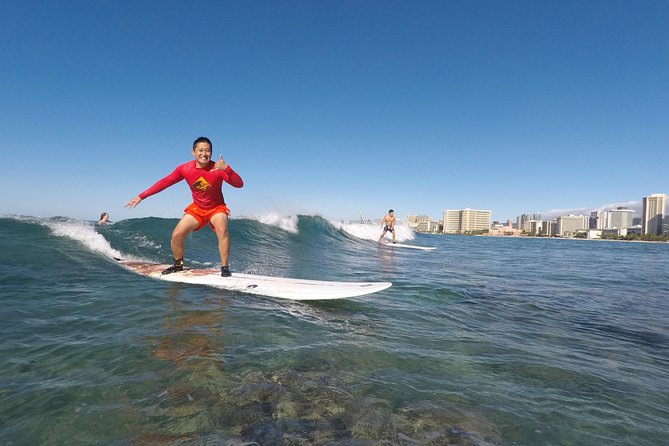
In one lesson experience, the pacing and positioning worked so well that even a nervous first-timer went from unsure to standing and riding. An instructor named Kevin was specifically praised for placing a beginner in the right spot, then encouraging progress until things clicked. You might not get Kevin, but it’s a good signal of how the teaching is meant to work: correct placement first, then momentum.
Don’t underestimate how much this reduces fear. A lot of beginner wipeouts are just hesitation plus wrong foot placement. Sand coaching helps fix both quickly.
First waves in the water: managing expectations in a group lesson
Once you’re in the lineup, you’ll still be doing “first wave” surfing, not chasing barrels. Your instructor stays with you and guides you so you feel safe and confident in the water. That guidance is especially valuable if you don’t already know how to read small swells or how to handle the board when you’re knocked off.
One thing to understand before you go: this is a group lesson. Some classes feel tight and efficient; others can be busier. In a larger group setup, the number of actual runs can feel limited, even if the instruction is great. Translation for you: don’t measure success by how many times you paddle up. Measure it by whether you’re standing more cleanly and improving each attempt.
If your priority is maximum time in the water, consider that a private lesson may suit you better. The operator notes that if you cannot swim, they may recommend a private lesson instead. Even if you can swim, if you’re dealing with injury concerns or you want deeper feedback, it’s worth asking.
Also: you’ll leash yourself to the board. That’s part of the safety rhythm. It helps you stay connected to your equipment, and it makes the whole process less frantic.
Try your hand at something island-made
- Open Group Surfing Lesson in Waikiki, Hawaii
★ 4.5 · 582 reviews - Oahu: Beginner-Friendly Waikiki Beach Surfing Lesson
★ 4.9 · 425 reviews - Surfing Lessons On Waikiki Beach
★ 4.5 · 317 reviews - Waikiki Private Group Surf Lesson
★ 5.0 · 298 reviews - Surf Lessons on the North Shore of Oahu
★ 5.0 · 267 reviews
Equipment included: what you don’t have to pack
For $119, the value isn’t just the instructor time. It’s that you don’t have to hunt down surf gear on an island where everything feels like a shopping trip.
Here’s what you get:
- Rash guard (helps with comfort and sun exposure)
- Reef shoes (useful for traction)
- Surfboard (the lesson board you’ll use throughout)
- A place to store belongings at the center
You’ll still bring essentials, too. The team asks that you come prepared: wear your bathing suit, bring a towel, and apply sunscreen ahead of time.
That sunscreen note is practical. Hawaii sun works fast. If you show up thinking you’ll do it once you arrive, you might end up sunburned before your first proper paddle.
Photos, videos, and souvenirs: having proof you were there
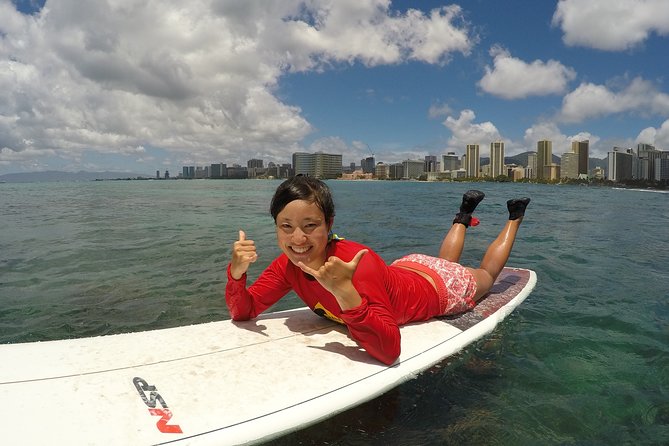
Not every surf lesson captures your effort. This one makes it easier to remember what happened out there. After the lesson, you return to the Ohana Surf Center where you can check out photographs, videos, or merch. If you’re surfing with family or friends, this can be a nice way to share the moment—especially for people who didn’t come to the beach with you.
It’s also reassuring if you’re your own worst critic. When you’re learning, you don’t always realize how close you were to a perfect ride. Having video gives you something to compare next time.
Souvenir photos aren’t included, but they’re available to purchase, so you can decide after seeing what’s captured.
Price and value: why $119 can be a smart Waikiki activity
Let’s talk money without getting weird about it. At $119 for about two hours, you’re paying for three things at once:
1) instruction from a pro who can correct mistakes quickly,
2) all the gear you’d otherwise rent or buy,
3) transportation between Waikiki and the surf center/beach area via courtesy shuttle (when offered) or a clear meet-up.
Surf lessons can easily turn into a scavenger hunt if you’re missing equipment, timing, or a meeting point. This format cuts the friction. You’re not juggling multiple vendors or figuring out how to get a surfboard across town.
Group lessons can also be great value because you get coaching without the full cost of one-on-one time. The tradeoff is that you may not get endless wave attempts. For most first-timers, that’s fine. Standing up and catching a wave at least once is the goal, and this lesson is set up to make that happen.
If you’re traveling as a family, the “small-group means more attention” theme is especially appealing. You’re more likely to get quick corrections when you’re learning, and that reduces the frustration that can come from feeling lost.
Who this lesson is best for (and who should adjust plans)
This program is set for people who can meet the basics:
- Students must be 13 or older.
- You must be able to swim.
- If you have medical conditions or injuries, you should tell the staff ahead of time.
In real life, I’d see this as an excellent fit for:
- first-time surfers who want a guided path from sand to ocean
- mixed-skill groups (parents and teens, friends at different comfort levels)
- people who want a structured Hawaii activity that still feels fun and active
It may be less ideal if you:
- need lots of one-on-one time to feel safe
- can’t swim (a private lesson may be recommended)
- want a heavy focus on advanced technique right away
Good news: even older beginners can do well. One experience included a 46-year-old who surfed with teens and came away ready for bigger waves next time—so this isn’t just for kids.
Timing, what to bring, and practical tips for comfort
This is a roughly two-hour experience. The exact flow can vary with conditions, but the shape stays the same: shuttle (or meet-up), check-in, gear up, safety briefing, beach practice, water time, then back to the center for photos/merch and the ride home.
To make it smoother, I’d plan around the things you control:
- Wear your bathing suit before you arrive.
- Bring a towel.
- Apply sunscreen before you go (not after).
- If you’re prone to seasickness, consider a remedy you already know works for you about an hour before. Talk to your doctor for guidance.
- If you want instruction materials in a specific language, the written materials are available in Spanish, Japanese, Korean, and Chinese, but the operator can’t guarantee matching-language instructors without advance notice—so tell them early.
Also, remember the group dynamic. You’ll learn faster if you listen, then ask a quick question when something doesn’t make sense. Don’t wait until you’re in the water with your head spinning.
Should you book this Waikiki surf lesson?
Yes, if you want a guided, beginner-friendly way to experience surf in Waikiki without turning it into logistics chaos. I like that the day is structured: transportation from select Waikiki areas, a real check-in base at Ohana Surf Center, gear provided, a safety briefing, and instruction that focuses on getting you standing up—not just paddling around.
Skip or consider a different option if you know you need one-on-one support, or if swimming ability is an issue. Also, if your group size ends up on the larger side, just accept that you might not get tons of repeated wave attempts. The win is learning and catching at least a few solid tries.
If you’re looking for a solid first surf session with a team that’s organized and encouraging, this one is a strong pick.
FAQ
How long is the surfing lesson?
It runs about 2 hours.
Where does the lesson start and end?
The activity starts at 2552 Kalākaua Ave, Honolulu, HI 96815, and it ends back at the meeting point.
Is transportation included?
Yes. Courtesy shuttle transportation is available from select Waikiki locations, and exact pickup details are emailed to you.
What’s included in the price?
You get a professional instructor, all necessary equipment (rash guard, reef shoes, and surfboard), all taxes and fees, storage for belongings, and transportation to and from designated meetings.
What should I bring?
Wear your bathing suit, bring a towel, and make sure you apply sunscreen ahead of time.
Do I need to know how to swim?
All students must be able to swim and be 13 or older. If you cannot swim, you should advise the staff, and a private lesson may be recommended.
Are souvenir photos included?
No. Souvenir photos and videos are available to purchase after the lesson.
Can I cancel for a full refund?
Yes. You can cancel up to 24 hours in advance for a full refund.
Do they offer materials in other languages?
Written materials are available in Spanish, Japanese, Korean, and Chinese. The operator will try to accommodate language needs, but they can’t guarantee matching-language instructors without enough advance notice.
Make Something Island-Made





More Tour Reviews in Oahu





Learn to Surf at Waikiki
Just Reviewed: More Oahu Tours






Waikiki Surf Lessons, compared.
 ★ 4.5Open Group Surfing Lesson in Waikiki, HawaiiFrom $112582 reviews
 ★ 4.9Beginner-Friendly Waikiki Beach Surfing LessonFrom $125425 reviews
 ★ 4.5Surfing Lessons On Waikiki BeachFrom $129317 reviews
 ★ 5.0Waikiki Private Group Surf LessonFrom $123298 reviews
 ★ 5.0Surf Lessons on the North Shore of OahuFrom $95267 reviews
 ★ 5.0Family, Private & Group Surfing Lessons, Waikiki Courtesy ShuttleFrom $107216 reviews
 ★ 4.9Waikiki 2-Hour Beginner Group Surf LessonFrom $103191 reviews
 ★ 5.0Private Surfing Lessons in WaikikiFrom $96176 reviews
Where else this tour ranks