
Reviewed · WAIKIKI SURF LESSONS
1.5-Hour Private Surfing Lesson in Honolulu
Catch your first Waikiki waves.
A private surf lesson in Honolulu gives you exactly what makes surfing feel possible: clear coaching, safety briefings on the sand, and then real time in the water on Waikīkī’s beginner-friendly breaks. You’ll also get local Hawaiian surfing etiquette tips so you’re not just standing there hoping nobody yells at you.
I love the sand-to-water structure. It starts with ocean awareness and surf safety, then moves right into wave reading and takeoff positioning with your instructor focused only on you. And I really like the safety training: instructors are trained in first aid and lifeguard CPR, so you’re in good hands if the ocean gets moody.
The one possible drawback is simple: you must be able to swim. If your swimming is shaky, it can hold back both your comfort and your progress, even with patient, supportive instruction.
In This Review
- Key things that make this lesson worth your time
- Waikīkī surf lessons work because you get coached, not “set loose”
- Meeting up at 2169 Kālia Rd: what the start feels like
- Sand training: ocean awareness, safety, and why it pays off
- The “private” part: one instructor watching your exact takeoff
- Reading waves in Waikīkī: what you’ll actually learn
- Surf etiquette in Honolulu: sharing the break like a local
- Safety that feels real: CPR training and quick response
- Photos on the waves: optional, exciting, and worth knowing the fine print
- Timing and what your 1.5 hours really includes
- Who this lesson is best for (and who should plan differently)
- Weather matters in Waikīkī, and the plan adapts
- Extras that can help you plan: rash guards and time outside the water
- Should you book this 1.5-hour private surf lesson?
- FAQ
- How long is the private surfing lesson?
- Where is the meeting point?
- Is this lesson private?
- What’s the minimum age?
- Do I need to know how to swim?
- What fitness level do I need?
- Do instructors have first aid training?
- Is a photographer included?
- What happens if the weather is bad?
- What is the cancellation policy?
Key things that make this lesson worth your time
- Sand safety first: you get an ocean-awareness and surf-safety rundown before you try standing up
- One instructor, your pace: private coaching means corrections and encouragement land fast
- CPR and first-aid trained team: added reassurance that you’re dealing with real risk, not just fun
- Wave reading coaching: you learn how to spot conditions and set up your takeoff
- Surf etiquette tips: you’ll get guidance on sharing Waikīkī responsibly
- Optional action photos: a photographer can capture the rides, with photos sold separately
Waikīkī surf lessons work because you get coached, not “set loose”
Surfing lessons can be hit-or-miss. You either get a lot of talking with zero feedback, or you get thrown into the chaos and told to figure it out. This private format is built to avoid both.
Your instructor begins with a personalized overview right where surf starts: on the sand. That matters because surfing is mostly decisions—what the water is doing, where to wait, when to paddle, and how to stay safe—before it’s about balance.
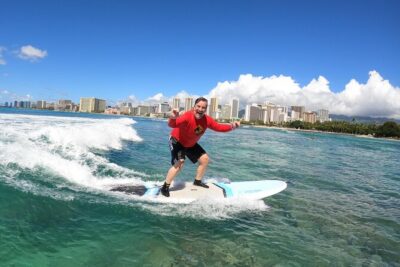
Then you move into the water and keep getting hands-on guidance. You’ll learn how to read waves for effective takeoff, and you’ll get real-time coaching that’s based on what you’re doing in that moment, not what you did 10 minutes ago.
Catch the gentle Waikiki rollers, more lessons
- Open Group Surfing Lesson in Waikiki, Hawaii★ 4.5 · 582 reviews
- Oahu: Beginner-Friendly Waikiki Beach Surfing Lesson★ 4.9 · 425 reviews
- Surfing Lessons On Waikiki Beach★ 4.5 · 317 reviews
- Waikiki Private Group Surf Lesson★ 5.0 · 298 reviews
Meeting up at 2169 Kālia Rd: what the start feels like
You meet at 2169 Kālia Rd, Honolulu, HI 96815. From there, your lesson begins at Waikīkī Beach with a sand briefing, so you’re not wasting time walking around hunting for the right spot.
Because the lesson is private, the pace is calmer than crowded group classes. You should still plan to arrive with a clear head and ready to listen, because the sand session sets the tone for everything that follows.
Expect a short but purposeful flow: safety talk, then wave awareness, then practice. If you’ve ever tried to learn a new sport while stressed, you’ll appreciate that structure.
Sand training: ocean awareness, safety, and why it pays off
The sand portion isn’t a formality. It’s where you learn how to behave around surf so you don’t get tangled up with the ocean or the people in it.
You’ll get a personalized overview of:
- ocean awareness and wave conditions
- surf safety basics
- how to think about what’s coming before you paddle out
This is where your instructor helps you connect the dots. For example, knowing what a wave is doing helps you choose when to go for it instead of guessing. It also helps you stay calmer when conditions change, which can happen quickly in Waikīkī.
I also like that this lesson is designed for real safety. Instructors are trained for first aid and lifeguard CPR, which signals they take risk management seriously.
The “private” part: one instructor watching your exact takeoff
A private surf lesson is only worth it if the coaching actually adjusts to you. That’s the whole point here: you’re not competing for attention.
In practice, this means your instructor can:
- correct your positioning and timing
- adjust instruction to your comfort level
- encourage you to try again right after a near-miss
Some lessons feel like they’re delivered from a distance. In this one, feedback stays close. One parent shared that Trevor was patient with a 7-year-old and made them feel extremely comfortable and safe, which is exactly what you want when you’re teaching kids something intense.
For older kids and confident swimmers, the private format also supports fine-tuning. Another parent described Tommy as supportive and patient with a 10-year-old, including bringing a student in when they got too cold and handling scrapes. That’s not just “nice service.” It changes the outcome because it keeps the learner from pushing past discomfort.
Your group only, more private trips
- Turtle Canyon Snorkel: Semi Private Boat Tour
★ 5.0 · 710 reviews - Waikiki Private Group Surf Lesson
★ 5.0 · 298 reviews - Family, Private & Group Surfing Lessons, Waikiki Courtesy Shuttle
★ 5.0 · 216 reviews - Private Oʻahu Helicopter Experience: All Window Seats
★ 5.0 · 209 reviews - Swim With Dolphins & Turtles in West Oahu (Semi-Private Tours)
★ 5.0 · 200 reviews
Reading waves in Waikīkī: what you’ll actually learn
Surfing looks like magic from shore. Up close, it’s mostly pattern recognition. Your lesson teaches you how to read waves and then act on what you see.
In the water, you’ll focus on:
- positioning for an effective takeoff
- understanding wave behavior enough to time your paddle
- surf etiquette so you don’t interfere with others
The big skill is takeoff setup. If you stand up too early or too late, you usually fall. If you paddle in the wrong spot, you miss the ride entirely. Your instructor helps you line up the moment you need.
This is also where a private lesson shines for first-timers. One solo rider said the instruction helped them feel comfortable and calm in the water, which is a huge deal when you’re new. Calm lets you think. Thinking lets you improve.
Surf etiquette in Honolulu: sharing the break like a local
Waikīkī can be fun and also busy. Even when waves look beginner-friendly, you still share space with others who are paddling, timing waves, and trying not to collide.
Your instructor gives you local guidance on Hawaiian surfing etiquette. The point isn’t to memorize a rulebook. It’s to understand how to respect the lineup so everyone has a safer, better session.
This is the kind of guidance that makes the difference between:
- surfing with confidence, and
- surfing while worrying you’re doing something wrong
And if you’re traveling with kids, etiquette matters even more. Your instructor can steer them toward the right behavior before habits form.
Safety that feels real: CPR training and quick response
Surfing includes real hazards: getting hit by a board, dealing with reef cuts, and handling fatigue in the ocean. This lesson is built with that in mind.
Instructors are trained in first aid and lifeguard CPR, which means you’re not relying on luck. You’re working with people who have prepared for emergencies.
One review highlighted an instructor providing bandages after a child got scrapes on the foot from the reef. That kind of response is exactly why safety training isn’t just paperwork.
For you, that translates into a practical takeaway: take reef protection seriously. A parent suggested reef walkers to help avoid cuts. You might not need them every day, but in Waikīkī they’re a smart idea if you’re prone to stubbed toes and sore feet.
Photos on the waves: optional, exciting, and worth knowing the fine print
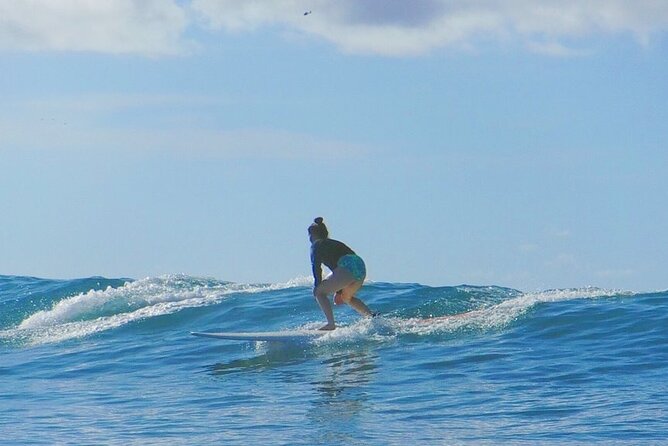
Action photos are available for purchase, and a photographer may be out on the water taking shots. Multiple reviews praised the photo service—one person said they got an email the evening of the lesson, could preview images, and then downloaded them easily after payment.
That’s the good news: if you want proof you actually stood up, photos can be a big confidence boost.
Here’s the consideration: photography is not part of the included price. Another review had a disappointment because the photographer plan didn’t match what was expected, and the person didn’t receive the photos they thought they were purchasing. It’s a reminder to confirm what your booking includes if photos are a must-have for you.
If you do buy the photos, also know that you may not get beach-level angles. One parent appreciated photos because they couldn’t take clear pictures from the shore due to how far out they were.
Timing and what your 1.5 hours really includes
The lesson runs about 1 hour 30 minutes. In that time, you’re not just learning tricks. You’re building the basics in a logical order.
Here’s what usually fills the block:
- Sand training: safety, ocean awareness, and wave basics
- Time in the water: wave reading, positioning, and takeoff practice
- Surf etiquette coaching as conditions and turns require
You’ll also see that instructors handle pacing. If someone is too cold, too nervous, or stuck in wipeout mode, the instructor can bring the surfer in and reset. One review described a 10-year-old being brought in when cold, then treated for small scrapes, and then continuing with support.
That kind of pacing is part of the value. It keeps the session productive and prevents a bad experience from snowballing.
Who this lesson is best for (and who should plan differently)
This lesson sets a clear baseline for participation:
- Minimum age is 5
- All participants must know how to swim
- Travelers should have moderate physical fitness
- You can book this as a private tour where only your group participates
If you’re bringing kids, there’s an extra rule that matters: anyone under 13 must book a Private Lesson (required). This is designed to keep children safer and make sure the instructor can focus without juggling multiple learners.
From the reviews, the private format clearly works for families. Parents praised instructors like Trevor with a 7-year-old and Tommy with a 10-year-old, both highlighting patient teaching and safety-minded care.
For adults and solo surfers, the value is the same, just a different vibe. A beginner said it helped them feel comfortable and calm, and that’s usually what separates an awkward first attempt from a fun one.
Weather matters in Waikīkī, and the plan adapts
Surf depends on conditions. This experience requires good weather, and if it’s canceled due to poor weather, you’ll be offered a different date or a full refund.
One family described a Saturday lesson being rescheduled because high tide meant there weren’t waves to ride. The rescheduled session still delivered a good experience the next day, which is the ideal outcome: you don’t lose the day, you get another shot when the ocean cooperates.
So when you book, keep your schedule flexible if you can. Surf rewards patience.
Extras that can help you plan: rash guards and time outside the water
Souvenir rash guards, shirts, and photos are available for purchase. None of those are required to ride, but they can be handy.
A practical note: if you’re planning to spend time in and out of the water, consider how you’ll handle sun and wind. Waikīkī sessions can go from warm to breezy fast, and comfort affects confidence.
Also, keep in mind you’re doing a physical activity right on the shoreline. Wear something you can move in. Bring the gear that makes you feel secure—especially if you’re protecting feet from reef contact.
Should you book this 1.5-hour private surf lesson?
If you want a first surf experience that’s structured, safer, and tailored, I’d say yes. The private format means your instructor can correct your technique and support your comfort in real time, which is exactly what beginners and kids need.
I’d only rethink it if you don’t meet the basic swimming requirement, or if you’re expecting guaranteed photos as part of the lesson. If photos are important, confirm what’s included for your specific booking before you go.
Otherwise, this is the kind of Waikīkī activity that turns vacation time into an actual skill moment. You get sand safety education, wave reading coaching, and a surfing start that feels guided rather than random.
FAQ
How long is the private surfing lesson?
The lesson is about 1 hour 30 minutes.
Where is the meeting point?
You start at 2169 Kālia Rd, Honolulu, HI 96815, USA, and the activity ends back at the meeting point.
Is this lesson private?
Yes. This is a private tour/activity, and only your group participates.
What’s the minimum age?
The minimum age is 5 years.
Do I need to know how to swim?
Yes. All participants must know how to swim.
What fitness level do I need?
You should have a moderate physical fitness level.
Do instructors have first aid training?
Yes. Instructors are trained in first aid and lifeguard CPR.
Is a photographer included?
Souvenir photos are available to purchase, but they are not listed as included. A photographer may be out taking photos for purchase.
What happens if the weather is bad?
If the experience is canceled due to poor weather, you’ll be offered a different date or a full refund.
What is the cancellation policy?
You can cancel for a full refund if you cancel at least 24 hours before the experience starts. If you cancel less than 24 hours before, the amount you paid is not refunded.
Your Crew Only



More Tour Reviews in Oahu





Learn to Surf at Waikiki


Just Reviewed: More Oahu Tours


Waikiki Surf Lessons, compared.
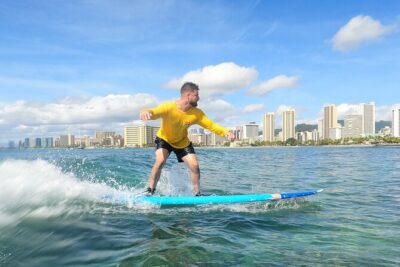 ★ 4.5Open Group Surfing Lesson in Waikiki, HawaiiFrom $112582 reviews
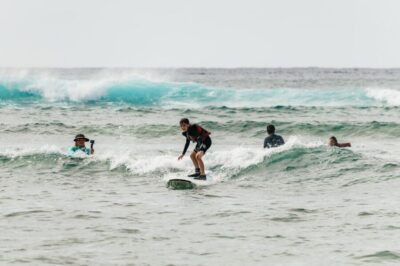 ★ 4.9Beginner-Friendly Waikiki Beach Surfing LessonFrom $125425 reviews
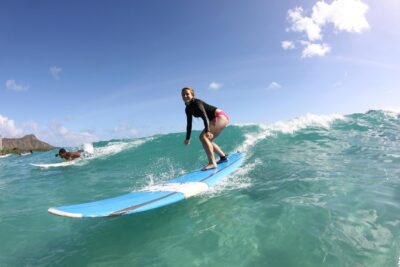 ★ 4.5Surfing Lessons On Waikiki BeachFrom $129317 reviews
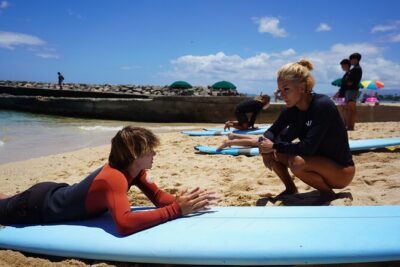 ★ 5.0Waikiki Private Group Surf LessonFrom $123298 reviews
 ★ 5.0Surf Lessons on the North Shore of OahuFrom $95267 reviews
 ★ 5.0Family, Private & Group Surfing Lessons, Waikiki Courtesy ShuttleFrom $107216 reviews
 ★ 4.9Waikiki 2-Hour Beginner Group Surf LessonFrom $103191 reviews
 ★ 5.0Private Surfing Lessons in WaikikiFrom $96176 reviews
Where else this tour ranks